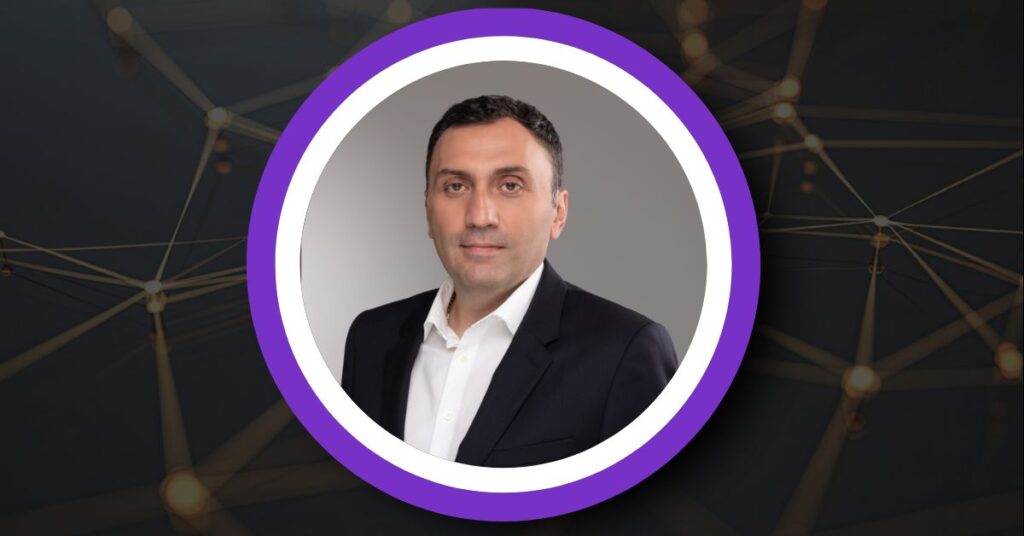
Head of Legal Department and Regulatory at Cellfie Irakli Esartia walks CEE In-House Matters through his leadership strategy, his professional journey, and how his take on risk has changed over the years. Esartia, who led the team responsible for developing the business case for the 4G license, shares what lessons senior legal professionals in highly regulated industries can learn from this experience, what skills are now essential for in-house counsels beyond traditional legal expertise, and more.
CEEIHM: You have been with Cellfie for nearly two decades. It’s relatively rare to see such long-term continuity in leadership roles today. What has enabled you to grow professionally within the organization?
Esartia: What enabled my professional growth at Cellfie was the opportunity to continuously evolve beyond a narrowly defined legal role. From early on, legal issues were closely connected to strategic decisions, regulatory positioning, and operational challenges, which required a deep understanding of the business rather than purely legal analysis.
Another important factor was trust. Over time, that trust translated into greater responsibility and direct involvement in executive decision-making, including periods where I took on broader leadership responsibilities. Working in a highly regulated and fast-changing industry also meant that growth often came through navigating uncertainty and complex situations, rather than following a linear career path.
CEEIHM: How is your legal team structured, and how do you measure its success?
Esartia: The team is structured around the realities of the business rather than traditional legal silos. Core areas such as regulatory affairs, litigation, compliance, and commercial support are closely integrated, with lawyers working directly with business units on an ongoing basis.
Success is not measured by volume of work or absence of disputes alone. We look at how effectively the legal team enables business decisions, manages regulatory risk, and anticipates issues before they escalate.
Equally important is credibility – both internally, with management and operational teams, and externally, with regulators and other stakeholders. If legal input is sought early and trusted, that is usually a good indicator we are doing our job well.
CEEIHM: You were closely involved in obtaining Georgia’s first 4G license. What made that process particularly complex from a legal and regulatory standpoint, and what lessons from that process would you share with legal leaders in other markets preparing for next-gen technologies?
Esartia: The complexity came not only from the regulatory environment, but from the need to align multiple disciplines around a single, high-stakes decision. I led the team responsible for developing the business case for the 4G license, working closely with the CFO, CCO, CTO, and CIO. Each brought a distinct perspective – financial, commercial, technical, and technological – and the legal and regulatory framework had to support all of them simultaneously.
From a legal standpoint, the challenge was managing uncertainty. There was limited precedent, evolving regulatory expectations, and significant long-term implications for the company. My role was to ensure that legal, regulatory, and risk considerations were embedded into the business case from the outset, rather than treated as constraints at the end of the process.
The key lesson for legal leaders is that next-generation technologies require lawyers to act as integrators. Success depends on the ability to lead cross-functional teams, translate regulatory uncertainty into structured decision-making, and help the business move forward confidently even when the legal framework is still taking shape.
CEEIHM: Has your view of risk changed over the years as both the company and the regulatory environment matured? If so, how?
Esartia: Yes, significantly. Early in my career, risk was something to be minimized wherever possible. With experience, I’ve come to see that in regulated industries, avoiding risk altogether can itself become a risk. Today, my focus is on understanding and managing risk in a way that aligns with the company’s strategic objectives. That means distinguishing between unacceptable risks and those that are manageable with the right controls, transparency, and governance. Maturity – both personal and organizational – allows for more nuanced judgment rather than purely defensive legal positions.
CEEIHM: How would you describe the current regulatory environment for telecom operators in Georgia?
Esartia: The environment is more structured and predictable than it was years ago, but it remains demanding. Regulation is evolving alongside technology, which creates both clarity in some areas and uncertainty in others. From a legal perspective, the key characteristic today is increased expectations – on compliance, consumer protection, and transparency. Constructive engagement with regulators has become essential. Operators that treat regulation as an ongoing relationship rather than a one-off obligation are better positioned to navigate this landscape.
CEEIHM: What regulatory or legal developments – be it challenges or opportunities – should telecom operators in Georgia be preparing for over the next five years?
Esartia: Over the next five years, telecom operators in Georgia will increasingly need to prepare for a broader regulatory landscape that goes beyond traditional telecom rules. As the industry continues its transformation from a pure connectivity provider into a more technology-driven company, legal teams will face growing overlap between telecom regulation and areas such as data protection, cybersecurity, digital services, and platform-related obligations.
This shift brings both complexity and opportunity. On the one hand, regulatory expectations will expand, particularly around data governance, consumer protection, and resilience of digital infrastructure. On the other hand, clearer frameworks in these areas can enable innovation if operators engage early and responsibly with regulators. For legal teams, this means moving from a reactive compliance model to a more strategic role – helping the business navigate the transition from telco to techco while ensuring that new services, partnerships, and technologies are built on a solid regulatory and legal foundation.
CEEIHM: What skills do you believe are now essential for in-house legal leaders beyond traditional legal expertise?
Esartia: Technology literacy has become a core skill for in-house legal leaders, particularly in industries like telecoms that are increasingly technology-driven. This does not mean becoming a technologist, but understanding how networks, data flows, platforms, and digital services actually function, and how legal risk arises within those systems. A legal leader who understands the basics of architecture, automation, data usage, and cybersecurity is better positioned to ask the right questions, challenge assumptions, and contribute meaningfully to strategic discussions. Without this understanding, legal advice risks being either overly cautious or disconnected from operational reality.
Beyond technology literacy, commercial awareness and communication remain essential. Legal leaders must translate complex legal and technical issues into clear, actionable guidance for management. Equally important is the ability to build trust across disciplines — acting as a bridge between legal, technical, and business teams as organizations continue to evolve from traditional operators into integrated technology companies.
CEEIHM: From your experience, what do lawyers fresh to in-house roles tend to underestimate in highly regulated industries like telecoms?
Esartia: They often underestimate how closely legal work is tied to operational realities. In telecoms, legal decisions rarely exist in isolation – they affect timelines, customer experience, and regulatory relationships. Another common underestimation is the importance of informal influence. Success is not only about being legally correct, but about being heard at the right moment, framing issues constructively, and contributing to solutions rather than simply identifying problems.