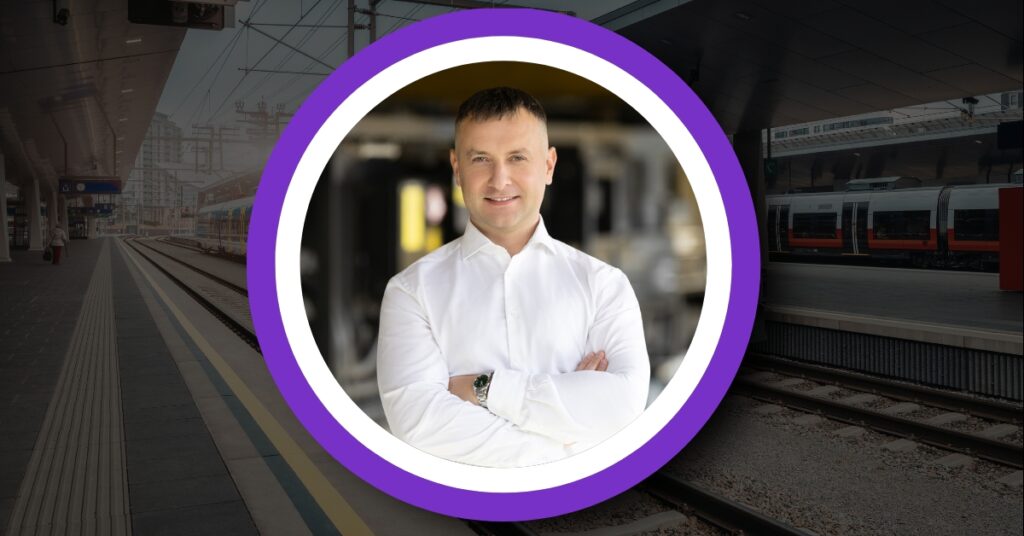
LTG Chief Legal & Governance Officer Irmantas Berzauskas discusses what lessons from the private sector proved useful in a state-owned organization, his role as part of the crisis management team at LTG as the war in Ukraine unfolded, and his view on how legal leaders should engage with other executives to support sustainable growth.
CEELM: Can you walk us through a typical day as Chief Legal & Governance Officer at LTG? How do you divide your time between managing the legal and governance function and contributing at the board level?
Berzauskas: A typical day in my role is a mix of strategic advising, decision-making, and collaboration. I don’t track my time precisely, but I’d estimate that a bit less than half of my day is spent leading the legal and governance teams – mentoring senior legal counsel and reviewing legal matters.
The larger portion of my time is focused on board-level contributions and working closely with the executive team. I’m grateful that my input on corporate strategy, risk management, and stakeholder engagement is valued and helps shape key decisions.
One exciting initiative currently underway is an AI testing project led by our legal team. It’s helping us explore new ways to improve both efficiency and quality, while also serving as a systematic model for other functions across LTG to begin experimenting with AI. This directly supports one of LTG’s strategic priorities: driving operational efficiency through innovation.
CEELM: You’ve spent more than a decade working at state-owned or state-controlled organizations. What lessons from the private sector have you applied, and which do you think the industry as a whole should consider?
Berzauskas: One key lesson from the private sector I try to apply daily is fostering a strong sense of ownership. While decision-making in state-owned organizations is understandably more cautious, empowering teams, simplifying processes, and focusing on outcomes can boost both speed and accountability.
For example, within the legal team, we’re currently concluding a management experiment called “Radical Ownership.” The core idea is my deliberate detachment from daily guidance and oversight of the legal and governance teams for one month – with only a few exceptions. We’re testing how this approach affects accountability, creativity, and motivation. I’m excited to see how management continues to evolve – what it truly means to be needed, and for what purpose.
More broadly, I think that legal and governance functions should be seen as strategic enablers, not just compliance roles. Boards and CEOs should give lawyers broader responsibilities and leverage their skills in scrutiny, reasoning, and problem-solving across areas like ESG, stakeholder engagement, project management, and commercial negotiations.
CEELM: You’ve led transformational corporate governance changes at LTG Group. What does “transformational” mean in practice, and what internal or external resistance did you have to overcome?
Berzauskas: “Transformational” at LTG meant reshaping our governance structure by introducing four non-executive boards, each led by an independent chairperson. Previously, only the parent company had a non-executive board. Now we have five non-executive boards. This change involved redesigning decision-making processes, clarifying accountability, and selecting professional board members.
The selection process was especially enriching for me personally – I had the rare opportunity to lead around 60 interviews with highly accomplished professionals who applied for board roles. It was a unique experience that deepened my understanding of leadership, governance, and the value of diverse perspectives.
One of the biggest challenges was shifting mindsets. We needed the existing leadership team to see incoming board members as a valuable resource for better decision-making, while also managing the expectations of those new members around their roles and responsibilities.
It’s still a work in progress, but the results are already visible: better decision quality, broader expertise within the organization, and a governance culture that enables progress rather than slows it down. It is worth noting that last year (2024), all key LTG Group companies received the highest A+ governance rating from Lithuania’s Governance Coordination Center – for the first time in the LTG Group’s history.
CEELM: As the war in Ukraine unfolded, you were part of crisis management at LTG. Can you walk us through how legal and compliance supported the company’s adaptation in that situation?
Berzauskas: I joined LTG Group just two days before the war began, while most of the company was still working remotely. There was no time for onboarding – decisions had to be made immediately. I’m deeply grateful to the legal team, whose support helped me navigate a sea of urgent issues without drowning.
The war caused a sharp drop in freight volumes, forcing LTG to implement a large-scale restructuring program. Around 25% of personnel were laid off, and major organizational changes followed: functions across the group were optimized and centralized, the hierarchy was flattened, and redundant roles were removed. The legal team was involved in every step, ensuring compliance, managing risks, and safeguarding business continuity.
CEELM: Infrastructure and transport are heavily regulated industries. What legal and governance trends do you see as most likely to reshape them in the next 5-10 years?
Berzauskas: Despite some recent slowdown, climate change and sustainability will remain the foundation of future regulation in infrastructure and transport. Stricter environmental standards, ESG reporting, and incentives for green technologies will continue to shape the industry.
Connectivity and digitalization will also play a much bigger role, introducing new risks and regulatory challenges – especially around data protection, AI, and operational transparency. Finally, I do see that infrastructure resilience and security, including cybersecurity, will become a major regulatory focus, particularly in the CEE region, where geopolitical risks are more pronounced.
CEELM: In your view, how should legal and governance leaders partner with other executives to support sustainable growth and long-term resilience?
Berzauskas: I would start by asking three key questions. First, do I clearly understand what sustainable growth and resilience mean for my organization? Without that clarity, it’s impossible to align legal and governance priorities with the bigger picture. Second, do I have the trust and support of the CEO and other executives to truly partner with them – and what unique value can I bring to their domains? And finally, a very practical question: Do I have the capacity, resources, and knowledge to deliver on these ambitions? After answering these questions, the “how” question becomes much easier to address.
CEELM: Looking back over your career, which role or project do you consider the most formative, and why?
Berzauskas: Every step in my career has shaped me in new ways, but I firmly believe character strengths define the journey. For me, it’s been a drive to compete, a commitment to lifelong learning, and a deep curiosity to understand things more thoroughly. These have guided me through every role and project and continue to influence how I lead today at LTG.
This article was originally published in Issue 12.10 of the CEE Legal Matters Magazine. If you would like to receive a hard copy of the magazine, you can subscribe here.